





Today we are proud to announce the launch of Athena AI in Tax Transitions, an agentic workflow that helps portfolio managers and financial advisors build, evaluate, and understand tax transition scenarios in a fraction of the time it takes to do so with traditional workflows.
This is not a chatbot bolted onto our platform. Athena AI sits between the user’s intent and our production optimizer, translating plain‑language requests into fully configured optimization runs and interpreting the results back into clear, actionable explanations.
The investment math is deterministic, driven entirely by our optimizer engine, but it’s important to know that the agent does not make investment decisions. You remain fully in control.
We built Athena AI to make human advisors faster, more informed, and able to handle more accounts. In this blog, I’ll pull back the curtain on the details surrounding our first agentic workflow for portfolio management.
Why We Started with Tax Transitions
Tax transitions are one of the most operationally demanding tasks in portfolio management. Moving a portfolio from one strategy to another while managing tax consequences requires simultaneous reasoning about unrealized gains and losses, wash‑sale exposure across related accounts, position‑level restrictions, and target model weightings.
A portfolio manager building a transition plan manually iterates through the optimizer repeatedly, adjusting parameters and checking constraint interactions until the output looks right. This process routinely takes 30 to 60 minutes per account.
Our platform has always had the optimization capabilities to handle this. But getting the most out of those capabilities required deep knowledge of the optimizer’s parameters. A manager needs to know which knobs to turn, by how much, and in what combination. The learning curve was significant, and even experienced users hit edge cases that demanded trial and error.
The Transition Agent eliminates that barrier.
How Athena AI’s Transition Agent Works
Athena AI processes the account’s current holdings, the target model or index, and the user’s stated requirements, gain constraints, position restrictions, trade preferences, to generate specific, implementable transition scenarios.
Each scenario is actionable: something you can execute to see concrete outcomes, not a theoretical exercise.
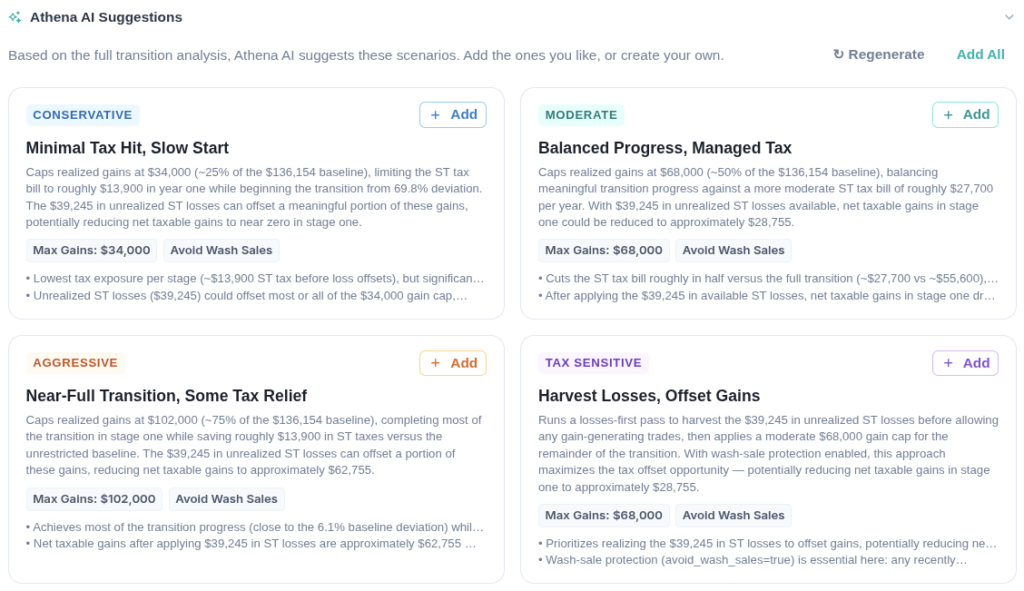
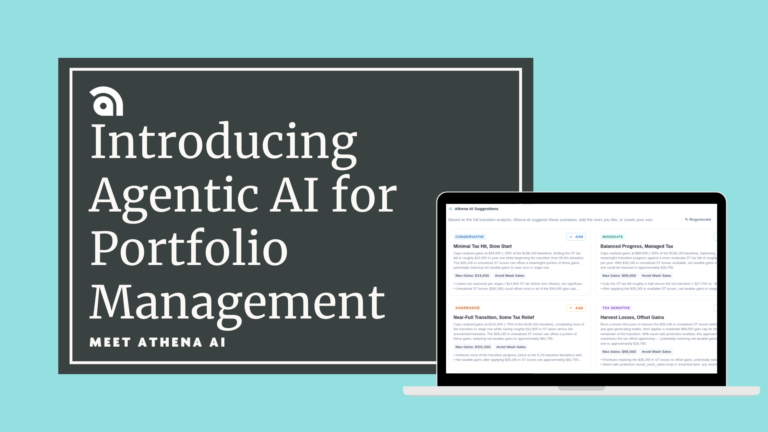
Image Description: Athena AI generates multiple transition scenarios, each with distinct tax and progress trade‑offs, for an account being transitioned to a Direct Index.
For an account with moderate unrealized gains transitioning to a direct indexing strategy, the Transition Agent generates four scenarios in under a minute: conservative (minimize the tax hit), moderate (balance progress with tax management), aggressive (complete most of the transition), and tax‑sensitive (harvest losses to offset gains). Each includes a clear explanation of its construction and trade‑offs. At the end of it all, the Transition Agent leaves it up to you to review each scenario and choose the best course of action.
Where the Transition Agent Earns Its Keep: Custom Scenarios
The initial suggestions are useful. But even greater value emerges when you instruct Athena AI to build custom scenarios in plain language.
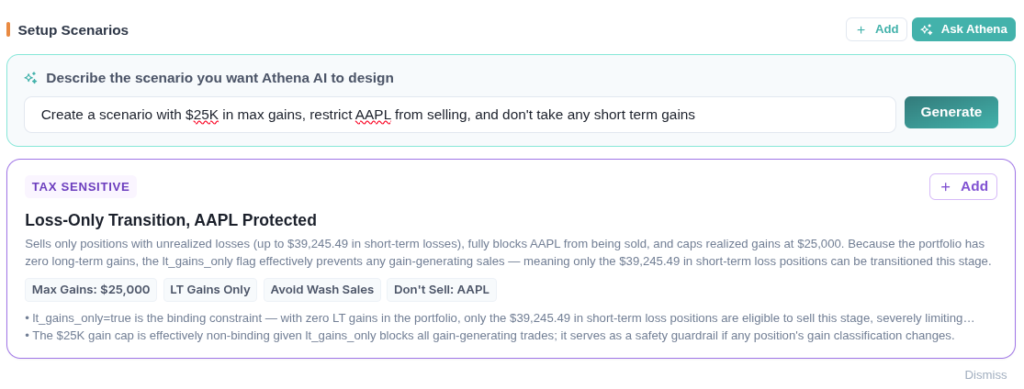
Image Description: A user requests a custom scenario. Athena AI reasons through the portfolio and identifies that the constraints effectively create a loss‑only transition.
What Separates Agentic AI from Automation
Imagine this: you may ask to create a scenario with $25K in max gains, restrict AAPL from selling, and no short‑term gains. A reasonable request.
But the Transition Agent, after analyzing the portfolio, recognizes something you might not have immediately seen: with zero long‑term gains in the portfolio, the long‑term‑only constraint combined with the gain cap blocks all gain‑generating trades. The scenario becomes a loss‑only transition.
Seeing this, the Agent explains the binding constraint and what is achievable.
This is what separates agentic AI from automation. Athena AI does not just execute the request literally. It reasons through the implications, identifies non‑obvious interactions between constraints, and explains the result so the portfolio manager can make an informed decision.
A well‑versed analyst would reach the same conclusion, but not as fast and not with the same comprehensiveness across every dimension of the portfolio.
Explaining What the Optimizer Actually Did
Building scenarios is only half the job. The other half is understanding the results.
A transition scenario produces a dense set of outputs: capital drift percentages, tracking error figures, realized gains and losses broken out by short‑term and long‑term, tax impact estimates, transaction counts, and multi‑year forecasts. An experienced PM can read these numbers, but connecting them to each other and back to the constraints that produced them takes real analytical work.
- Why is tracking error still elevated despite significant trading activity?
- Why did the optimizer harvest these specific losses but not others?
- Why is capital drift higher than expected when the gain budget was not fully consumed?
Athena AI answers these questions directly, in plain language, with specifics.
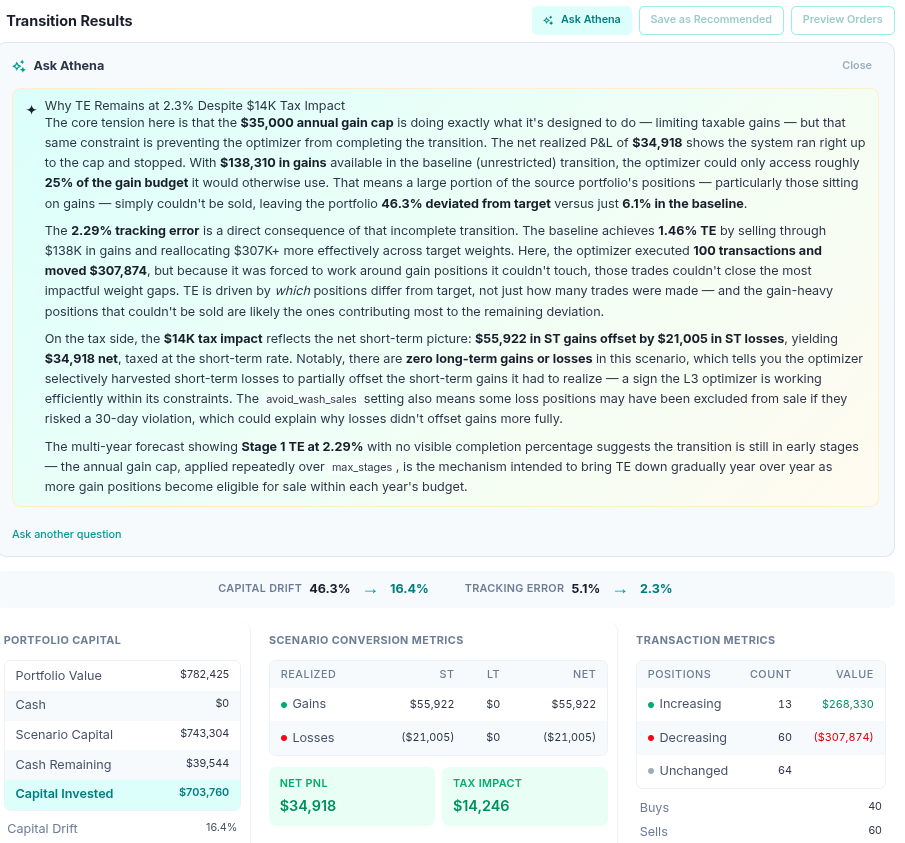
Image Description: A user asks why tracking error remains at 2.3% despite a $14K tax impact. Athena AI traces the answer through the gain cap constraint, capital drift composition, loss harvesting behavior, and the multi‑year transition forecast.
In the example above, a user is looking at a scenario where the optimizer executed 100 transactions moving $307K in capital, realized $34,918 in net gains with a $14K tax impact, but left tracking error at 2.3% and capital drift at 16.4%. The natural question is: why did all that activity not get the portfolio closer to target?
How Athena AI Explains Its Reasoning
The agent explains that the $35,000 annual gain cap is the binding constraint. With $138K in gains available in the baseline, the optimizer could only access roughly 25% of the gain budget before hitting the cap. Gain‑heavy positions sitting furthest from target could not be sold. Tracking error is driven by which positions differ from target, not just how many trades were made, and the positions contributing most to tracking error are precisely the ones the gain cap prevented the optimizer from touching.
The Agent connects this to the loss harvesting behavior: the optimizer selectively harvested short‑term losses to partially offset gains, with the wash‑sale avoidance setting potentially excluding some loss positions that risked a 30‑day violation. It then points to the multi‑year forecast, explaining that the transition is designed to play out over multiple annual gain budgets as more positions become eligible for sale.
This is the kind of analysis that a senior PM could produce, but it would take them meaningful time to trace through the optimizer’s logic, cross‑reference the constraint settings, and connect the numbers. The agent does it on demand, for any scenario, in seconds.
Athena AI is Built on Four Non‑Negotiables
Portfolio management has zero room for “close enough.” We built Athena AI around four principles that are engineering requirements, not aspirations:
Reliable. Actual portfolio data and optimization logic is the foundation for every scenario. Athena AI must produce no hallucinations, so it can implement every output.
Repeatable. Same inputs produce the same outputs. No randomness, no drift between runs.
Predictive. The agent anticipates implications the user might not see, like recognizing that a combination of constraints transforms a transition into a fundamentally different operation.
Explainable. Every scenario includes a clear rationale: what constraints were binding, what trade‑offs were made, what to pay attention to. An agent without explainability is an agent nobody will use.
The Bigger Picture
The Transition Agent is our starting point, not our endpoint. We are building Athena AI into the entire portfolio management workflow: rebalancing, tax‑loss harvesting, cash management, compliance monitoring, client reporting. Every function that currently requires deep optimizer expertise or outsourcing to a TAMP is a candidate for agentic augmentation.
We have already seen strong evidence that advisors are ready for this shift.
Firms that previously outsourced complex portfolio management, including personalized direct indexing and active tax‑loss harvesting, are bringing those capabilities in‑house by adopting our platform.
These are not firms running basic model portfolios. They are running fully customized, tax‑aware strategies with client‑level personalizations. The exponential growth in AUM on our platform, from boutique RIAs to large enterprises, confirms the appetite.
To complement the launch of Athena AI, we’ve written a new white paper: The Agentic Shift: How Agentic Workflows Will Disrupt Outsourced Portfolio Management, which examines the broader market dynamics driving this transition, including the $13.7 trillion managed account ecosystem, the economics of TAMP outsourcing, why portfolio management agents are harder to build than CRM or marketing agents, and why we believe AI‑native platforms will capture significant share.
We encourage anyone interested in the strategic thesis behind Athena AI to read it alongside this announcement.
We still fully believe that investment decisions should stay with the advisor. Athena AI just makes getting there faster, clearer, and scalable.